RECN 2.0
Expanding access to college credit in high school
The Center of Excellence in Leadership of Learning (CELL) at the University of Indianapolis has received a $10 million federal Education and Innovation Research grant to begin the Rural Early College Network (RECN) 2.0. RECN 2.0 will help rural high schools implement Early College programs, expanding access to advanced coursework and helping more educators earn dual credit credentialing. RECN 2.0 will serve 11,000 rural students across 20 districts.
Contact Steve Combs, Director of Early College, at combss@uindy.edu with questions or for more information.
75% of graduates from endorsed Early College High School programs in the RECN network went on to college in 2022, compared to 53% of Indiana graduates
The Need: Indiana's Rural Student Population
Rural students often face barriers in accessing college credit opportunities during high school and the support systems that help prepare them for college. By helping rural high schools implement an Early College program, the RECN project overcomes barriers to help more rural students go to college and succeed when they get there.
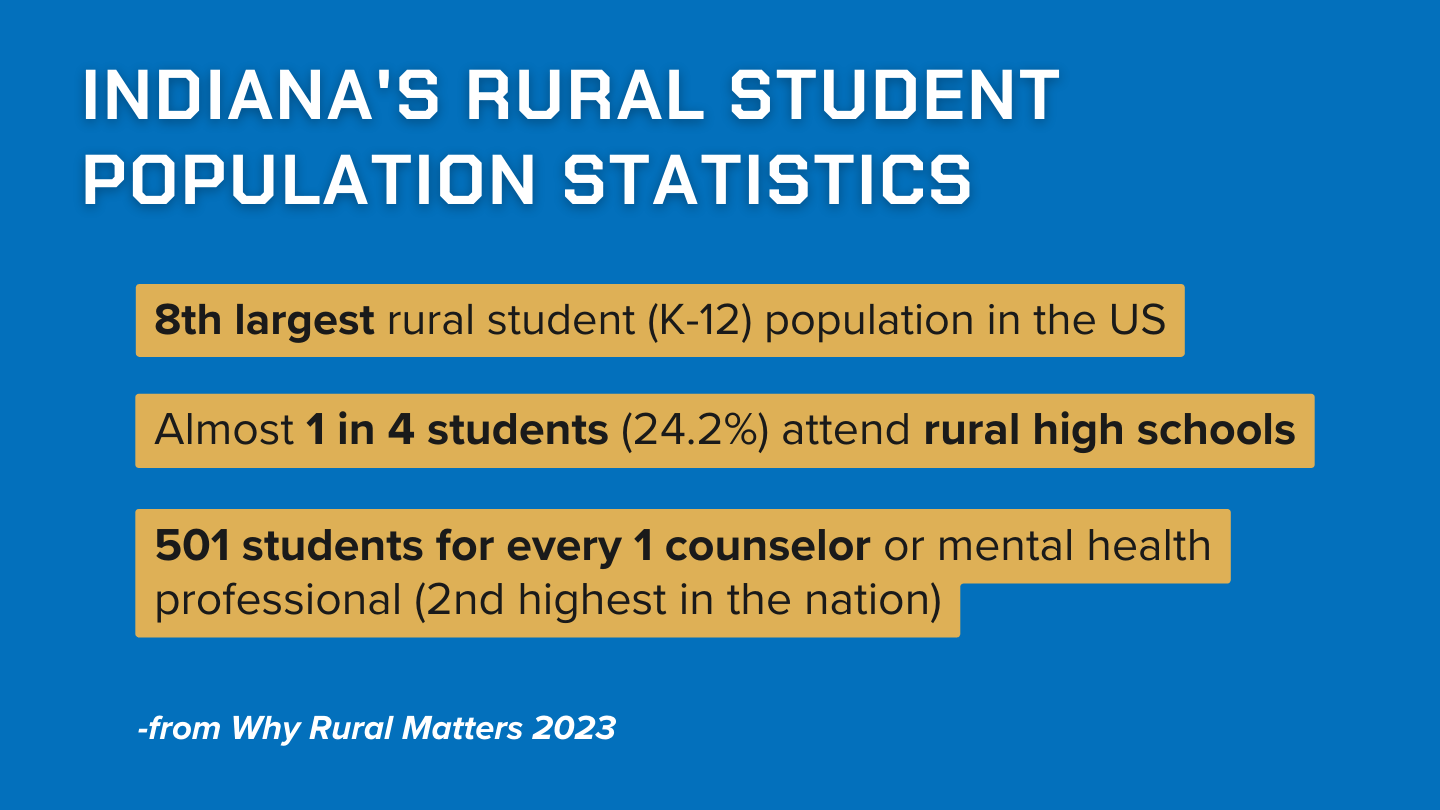
- 8th largest rural student (K-12) population in the US
- Almost 1 in 4 students (24.2%) attend rural high schools
- 501 students for every 1 counselor or mental health professional (2nd highest in the nation)
The RECN Model
Building on lessons learned from RECN 1.0, RECN 2.0 harnesses the power of collaboration and peer learning by designating five rural schools with endorsed Early College High Schools as mentor schools. Fifteen partner schools—schools implementing an Early College program and pursuing endorsement—were selected by CELL and were grouped and paired with a mentor school.
Quads and the RECN Network
The RECN mentor-partner school groups, or "quads," are a key structure of the project, allowing school leaders to see other programs in action, learn from one another, and explore problems of practice together. In addition to the foundational quad meetings and full network meetings, RECN features different kinds of professional development and cross-school collaboration opportunities, including principal leadership teams, and school leadership teams within each school.
RECN Schools
Mentor Schools
- Logansport High School, Cass County, Logansport, IN
- Rising Sun High School, Ohio County, Rising Sun, IN
- Sheridan High School, Hamilton County, Sheridan, IN
- Southridge High School, Dubois County, Huntingburg, IN
- Winchester Community High School, Randolph County, Winchester, IN
Partner Schools
- Angola High School, Steuben County, Angola, IN
- Brownstown Central High School, Jackson County, Seymour, IN
- Fairfield High School, Elkhart County, Goshen, IN
- Frankfort High School, Clinton County, Frankfort, IN
- LaVille Jr/Sr High School, St. Joseph County, Lakeville, IN
- Marion High School, Grant County, Marion, IN
- Mt. Vernon High School, Hancock County, Fortville, IN
- North Montgomery High School, Montgomery County, Crawfordsville, IN
- NorthWood High School, Elkhart County, Nappanee, IN
- Peru Junior/Senior High School. Miami County, Peru, IN
- Rushville Consolidated High School, Rush County, Rushville, IN
- South Vermillion High School, Vermillion County, Terre Haute, IN
- Southmont High School, Montgomery County, Crawfordsville, IN
- Union County High School, Union County, Liberty, IN
- West Vigo High School, Vigo County, Terre Haute, IN
Contact
Interested in more information about the Rural Early College Network? Contact Steve Combs, Director of Early College, at combss@uindy.edu.
The Rural Early College Network (RECN) 2.0 project is being funded entirely through federal support, with 100% of the total project costs–amounting to $9,997,658.00–financed by federal funds. No portion of the project’s cost will be financed by non-governmental sources.
The contents of this webpage were developed under a grant from the U.S. Department of Education, Education Innovation and Research (EIR) Program. The Department does not mandate or prescribe practices, models, or other activities described or discussed in this document. The contents of this webpage may contain examples of, adaptations of, and links to resources created and maintained by another public or private organization. The Department does not control or guarantee the accuracy, relevance, timeliness, or completeness of this outside information. The content of this webpage does not necessarily represent the policy of the Department. This publication is not intended to represent the views or policy of, or be an endorsement of any views expressed or materials provided by, any Federal agency.