Student Impact
Old Test, New Path to College Credit at Mishawaka High School

It wasn’t just one thing that bothered her. It was two.
Mishawaka High School Associate Principal Jessica Mann couldn’t shake the sense that something didn’t add up. Fluent Spanish speakers automatically taking introductory Spanish courses, while advanced French students faced a tough choice: risk their GPA or give up college credit.
Different students. Different pressures. Same problem.
The path to college credit needed rethinking.
So she started exploring what it would take to try something new.
It’s the kind of innovation CELL is recognizing through our 25th anniversary Celebrate Your School Awards. For Mishawaka High School, it led to a new approach to dual credit—one that reimagines how the CLEP exam can give students a head start on college.
The path to college credit needed rethinking.
Lost in Translation
The challenge first presented itself in French. The rigors of the dual credit upper-level courses caused students to forgo college credit in French III and IV to maintain their grade point averages. However, as an unintended consequence, they were left without a way to earn the Indiana College Core.

At the same time, native Spanish speakers in eighth grade were automatically enrolled in the introductory Spanish course as freshmen. Even with strong speaking and listening skills, Mishawaka lacked a way to translate that fluency into admission to the advanced Spanish courses that offered dual credit.
A conversation with a parent from Guatemala wanting her children’s native Spanish language skills recognized prompted Mann to think, “Okay, we need to have a process for this.”
Mann was aware of the College-Level Examination Program (CLEP) through College Board, but now had a reason to take a closer look. Could the test offer a new way to recognize what students already knew and translate it into dual credit?
Testing a New Approach
The answer started with a pilot.
Mann formed a team to test whether CLEP could offer an alternative path to college credit. They began with a group of 17 students, including native Spanish speakers identified in middle school and high school students taking upper-level French. The group was a mix of lived experience and learned skills—students who knew the language because they spoke it every day, and those who had spent years studying it in the classroom.
With funding in place to cover CLEP costs, the pilot offered a low-risk way to test the idea. The team didn’t know how students would perform, but the potential payoff made it worth trying.
With all the details finalized, students prepared for and sat for the exams. What many received back was more than a simple test score.
The CLEP pilot offered a low-risk way to test the idea. The potential payoff—a significant head start on college—made it worth trying.
The Results Are In
“As a result of this team effort,” Mann said, “six students earned a total of 72 free college credits, with multiple earning one to two full years of college World Language credit. In total, this project cost the district $1,500 but earned the equivalent of more than $12,800 in Ivy Tech credits for students.”
For native Spanish speakers, the impact was especially meaningful. Many of these students would be the first in their families to attend college. “I was absolutely delighted to give students who would have been placed in Spanish I the opportunity to have their language skills recognized,” Mann said.
Just as important was the confidence it built. Students who may not have seen themselves on a college path now had tangible proof they could succeed—some earning as many as 14 credit hours before even starting high school.
The CLEP pilot represented a second chance for students taking French, offering a different way to demonstrate their knowledge. Instead of choosing between protecting their GPA and earning college credit, they had a viable way to do both, keeping their progress on track and their college goals within reach.
“I was absolutely delighted to give students who would have been placed in Spanish I the opportunity to have their language skills recognized.” -Dr. Jessica Mann, associate principal, Mishawaka High School
Before Anyone Picked Up a Pencil
What made the results possible was a coordinated effort across classrooms, buildings, and partners.
Mann worked closely with teachers, counselors, and Ivy Tech to bring the pilot to life. At the middle school, the Multilingual Learner (MLL) teacher helped identify native Spanish speakers who had the proficiency to succeed, sitting down with students to explain the opportunity and what it would take to participate. At the high school, the upper-level French teacher encouraged students to take part while helping gauge readiness, ensuring they were positioned to benefit from the experience.
Counselors played a critical role in connecting the pieces. They worked across both buildings, communicating with families, answering questions, and helping students understand what earning college credit through CLEP could mean for their future. For one counselor, the work was especially personal. As a fluent Spanish speaker who once went through the same experience of not receiving credit for her language skills in school, she understood firsthand what this opportunity could mean for students and their families.
Behind the scenes, the logistics were just as important. The school covered the cost of exam vouchers, coordinated payment with Ivy Tech’s testing center, and organized transportation so students could take the exam in a college testing environment. Staff members ensured students were prepared not just academically, but also for the experience of testing outside their usual classroom setting.
Mishawaka’s innovative work demonstrates that “expanding access to college credit doesn’t have to mean large budgets or complicated systems—it simply requires creative thinking, strategic partnerships, and a belief in students’ potential,” Mann said.
"Expanding access to college credit doesn’t have to mean large budgets or complicated systems—it simply requires creative thinking, strategic partnerships, and a belief in students’ potential."
Test One of Many
The concept worked. Now in year two, the program is growing.
Using funds from their Celebrate Your School Award, 22 students are taking the CLEP exam in French this spring. But the vision goes beyond world languages.
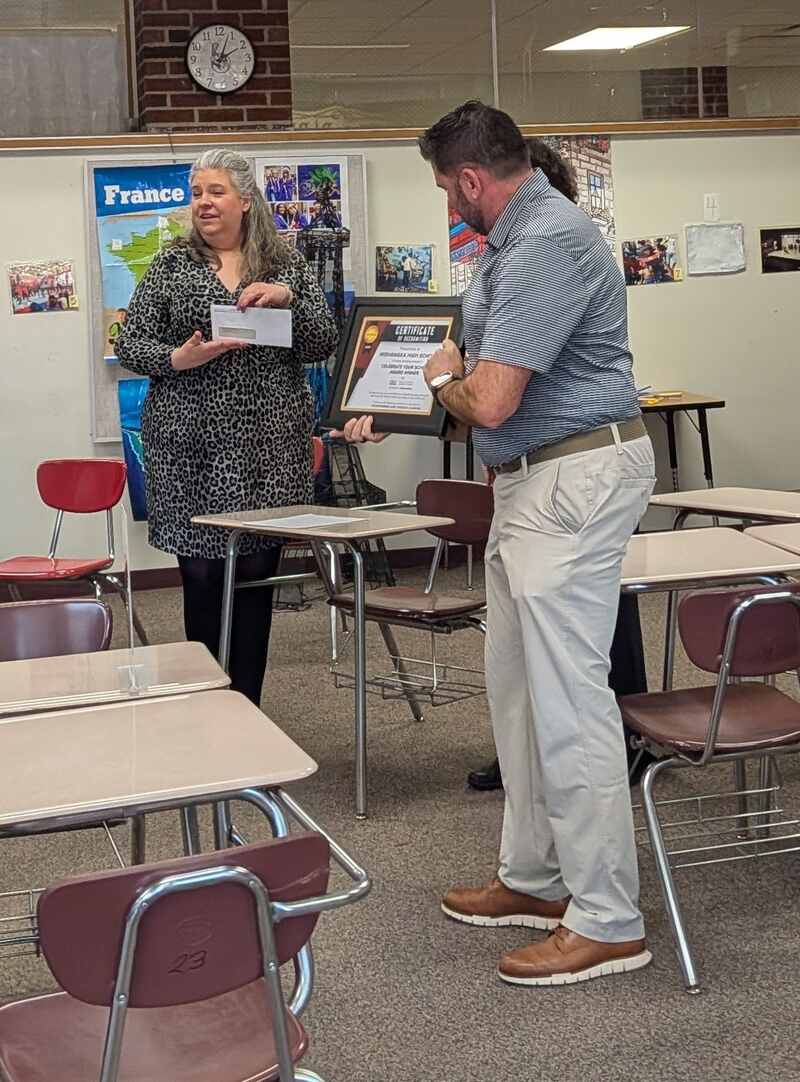
“Soon it won’t just be CLEP in Spanish or French,” Mann said. “I see students taking a wide variety of these CLEP exams. There are options in business, history, and economics. It really opens up possibilities for students.”
That flexibility is becoming increasingly important.
“I think it’s going to become harder to credential teachers for dual credit moving forward,” Mann said. “It’s also going to be harder to find qualified teachers, let alone those who are dual credit qualified. Schools are going to have to get creative because of the pressure to offer the Indiana College Core.”
What started as a way to solve a problem has become a program centered on access and opportunity.
“Our initiative shows that the CLEP exam can be leveraged as a powerful and equitable alternative when traditional dual credit options are unavailable,” Mann said. “When barriers are removed and expectations are raised, students achieve at levels that change their future.”