School-Wide Practice Change
Rural Early College Network Reflects on Success and Prepares for Growth in 2025
The Rural Early College Network (RECN), led by the Center of Excellence in Leadership of Learning, is kicking off 2025 with momentum and new opportunities following five years of measurable success. Designed to expand access to Early College in rural communities, the initiative exceeded its goals, creating lasting benefits for students, educators, and communities across Indiana.
Since RECN’s launch in 2019, the initiative has served 23,091 students.
Accelerated Endorsements and Student Impact
RECN set an ambitious goal to accelerate Early College endorsements for its Partner schools. All 15 schools achieved this milestone—exceeding the initial target of 12—and completed the process in just 1.5 to three years, compared to the usual three to five years. Since RECN’s launch in 2019, the initiative has served 23,091 students, 44% of whom come from socioeconomically disadvantaged families.
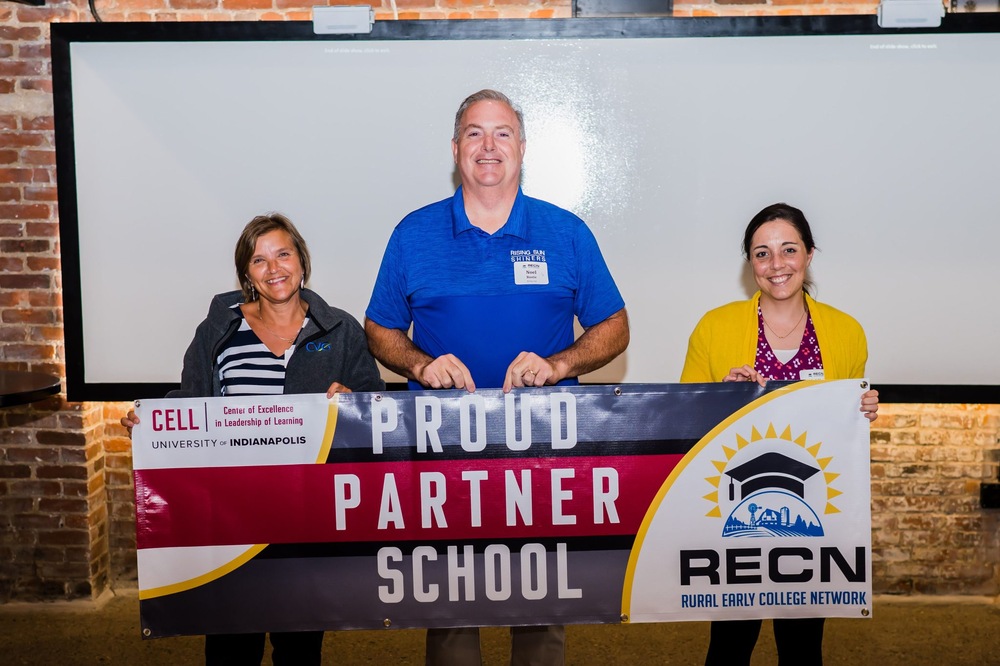
“Rising Sun High School was honored to be part of the inaugural Rural Early College Network (RECN) through CELL,” said Noel Bostic, principal of Rising Sun High School. The project provided invaluable insights and core principles that allowed us to become an endorsed Early College High School. Through networking with other rural schools in RECN of similar size plus connected mentoring from CELL, our Early College program has thrived. Today, 25% of our graduating classes consistently earn an associate degree.”
“The opportunity to gain dual credit credentialing through RECN has been such a blessing to my community and myself.” —Lana Swanson, teacher, Logansport High School
Investing in Teachers for Dual Credit Access
The success of the Early College model’s dual credit pathways relies on highly skilled, highly trained teachers. Thanks to RECN, 37 additional teachers have the credentials to teach dual credit courses, with 34 more currently enrolled in graduate programs and 22 preparing to start coursework. Across RECN’s 20 Partner and Mentor schools, 127 educators now have the qualifications to teach these college-level classes.
“The opportunity to gain dual credit credentialing through RECN has been such a blessing to my community and myself,” said Lana Swanson, a math teacher at Logansport High School. “By assisting me in completing college-level courses, I am now able to help students gain valuable knowledge while earning college credits, which will save them so much time and money in the future!”
“The next phase of RECN builds on the incredible impact we’ve achieved over the past five years.” —Janet Boyle, Rural Early College Network director, CELL
National Recognition and Family Savings
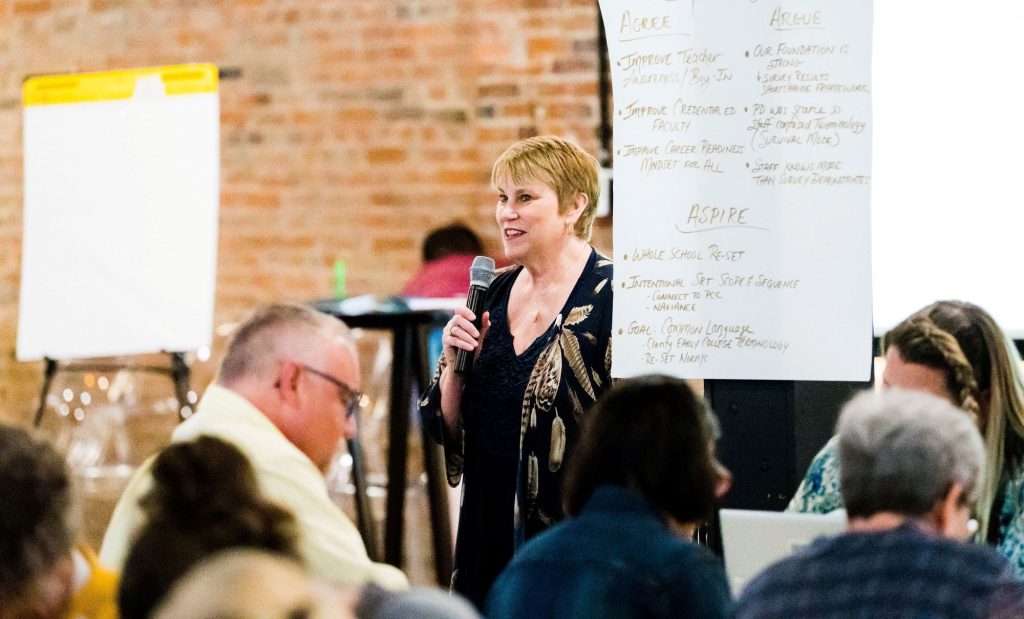
RECN’s success has gained national recognition. In 2024, CELL staff presented at major conferences, including the National Forum to Advance Rural Education, National Alliance of Concurrent Enrollment Partnerships, National Summit for Dual Credit Partnerships, Early College Research Conference, and Education Innovation and Research Director’s Meeting. These presentations highlight RECN’s innovative approach and best practices for scaling Early College and dual credit access in rural areas.
Families also reaped major financial benefits. RECN’s schools—ranging in size from 200 to 1,800 students—increased the number of students earning dual credit annually. These schools collectively will save students and families more than $15 million in tuition costs by the close of 2025.
Looking Ahead: Expansion Opportunities
As 2024 concluded, CELL secured a second round of federal funding worth $10 million to expand RECN to 15 additional schools statewide. Applications for rural high schools to join the network are open March 3-28, with the new cohort launching in June 2025.
“The next phase of RECN builds on the incredible impact we’ve achieved over the past five years,” said Janet Boyle, director of the Rural Early College Network at CELL. “By involving more schools in this work, we’ll continue making college accessible, attainable, and affordable for thousands of Hoosier students.”
—